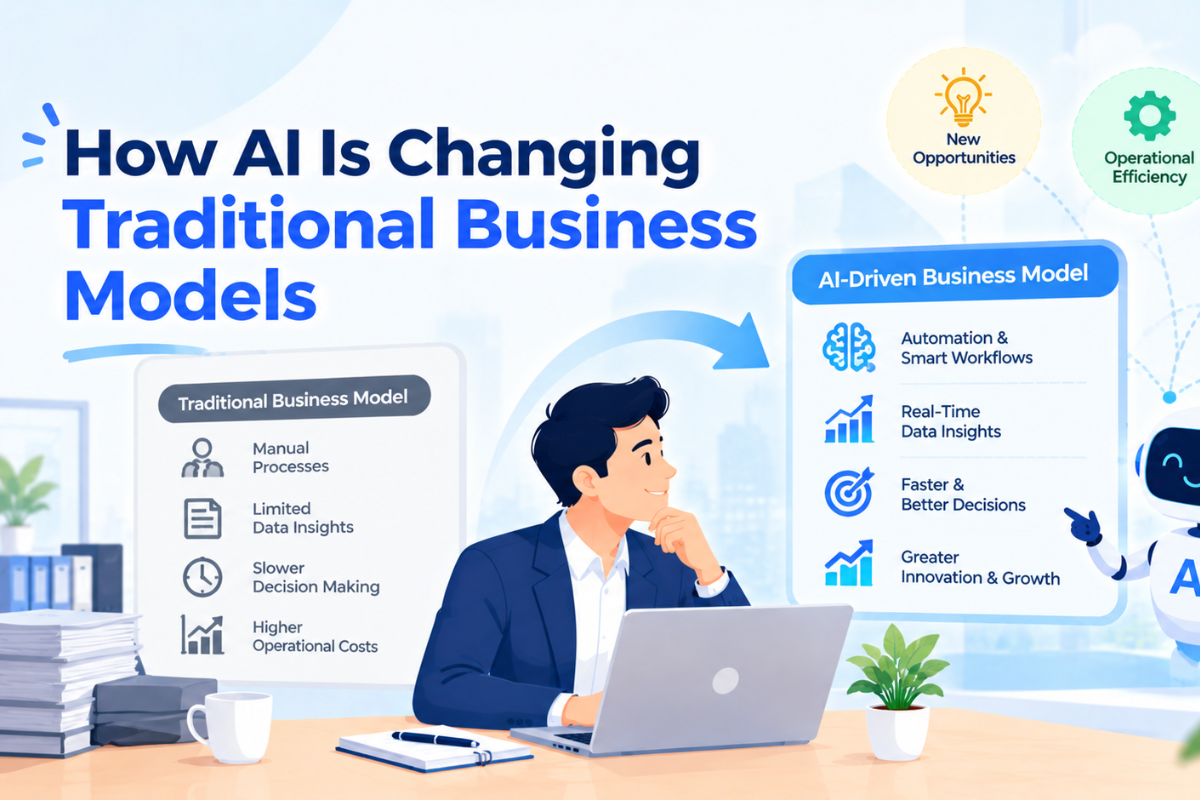
How AI-Powered Search Is Changing Information Search

The way people search for information is changing. For years, search engines relied mainly on keywords, links, and ranked web pages to help users find answers. Today, artificial intelligence is making search more conversational, contextual, and focused on providing direct answers.
AI-powered search allows users to ask questions in natural language instead of relying only on short keyword phrases. AI systems can understand the context behind a query, identify relevant information, summarize results, and sometimes provide a complete response without requiring users to open multiple websites.
This shift is changing how people discover information and how websites create content. From conversational queries to AI-generated summaries, search is becoming less about finding a list of links and more about helping users understand a topic.
What Is AI-Powered Search?
AI-powered search uses artificial intelligence technologies to understand search queries and provide more relevant information. Traditional search engines generally match keywords with information available on web pages and rank those pages based on different signals.
AI search technology adds another layer of understanding.
Instead of simply matching words, AI systems can analyze the meaning and context of a query. They can understand follow-up questions, connect related concepts, summarize information, and present answers in a more conversational format.
For example, a traditional search might involve searching for:
“best laptop for students”
An AI-powered search query could be:
“I need a lightweight laptop for university assignments, video calls, and basic editing. What features should I look for?”
The second query provides more context. An AI search system can use that context to produce a more personalized and useful response.
How Does AI-Powered Search Work?
AI-powered search combines several technologies to understand queries and retrieve useful information.
Natural language processing helps AI systems understand how people communicate. Instead of treating every word independently, the system can analyze the meaning and relationship between words.
Machine learning can help search systems identify patterns in user behavior and information. Generative AI can then help organize and summarize relevant information into a readable response.
A simplified AI search process can look like this:
- The user enters a question.
- The AI system analyzes the meaning and context.
- Relevant information is identified from available sources.
- The system evaluates and organizes the information.
- AI generates or summarizes an answer.
- Sources or links may be provided for additional information.
The exact process varies between AI search tools and platforms. However, the overall goal is to understand what the user actually wants rather than simply matching exact keywords.
How AI Search Differs From Traditional Search
Traditional search engines remain useful for many types of queries. They are particularly effective when users want to find a specific website, product, location, or piece of information.
AI search changes the experience by focusing more on direct answers and conversations.
With traditional search, users may enter a query, review several results, open different pages, compare information, and form their own conclusion.
With AI-powered search, the system can summarize information from multiple sources and provide a response within the search experience.
This does not mean AI search completely replaces traditional search. Instead, the two approaches can work together.
Users may use AI for research and exploration while still visiting websites for detailed information, original sources, product pages, documentation, and other specific resources.
AI Search Is Changing How People Ask Questions
One of the biggest changes created by AI search is the way people formulate queries.
Searches are becoming more conversational.
Instead of typing several disconnected keywords, users can ask complete questions and provide additional context.
For example:
Traditional search:
“best smartphones battery life”
Conversational search:
“Which smartphones have good battery life for someone who spends most of the day working, watching videos, and using navigation?”
AI systems are designed to understand longer and more detailed queries.
Users can also continue a conversation without repeating the original question.
For example, someone could ask about smartphones and then follow up with:
“Which one would be better for photography?”
The system can use the earlier context to understand what “which one” refers to.
This makes information discovery feel more like a conversation than a series of separate searches.
Conversational Search Makes Information Easier to Explore
Conversational search can make complex research easier because users do not always need to know the exact keywords to use.
A user researching cloud computing, for example, might start by asking what cloud computing means. They could then ask about its benefits, security concerns, costs, and common use cases.
This creates a connected research process.
AI search tools can also help users simplify technical subjects, compare concepts, generate examples, and identify related questions.
However, users still need to evaluate important information carefully. AI-generated answers can contain errors, incomplete explanations, or outdated information depending on the system and its sources.
AI Summaries Are Changing Search Results
Another major development in AI-powered search is the use of AI-generated summaries.
Instead of displaying only traditional search listings, some search experiences can provide a summary of information at the top of the results.
This can be useful when users want a quick explanation.
For simple questions, an AI summary may provide enough information without requiring several clicks. For more complex topics, users can continue researching through cited sources and individual websites.
This creates an important change for publishers and businesses.
A website may receive visibility within an AI-generated answer even when the user does not immediately click through to the website.
As a result, brands increasingly need to think about how their content can become a useful and trustworthy source of information.
How AI Search Engines Find and Organize Information
AI search engines can use multiple methods to find and organize information.
Depending on the platform, they may use search indexes, web content, structured data, knowledge bases, real-time information, or other sources.
AI models can then help understand relationships between different pieces of information.
For example, if a user searches for information about electric vehicles, an AI search system may need to understand concepts such as battery range, charging infrastructure, charging time, vehicle models, and ownership costs.
The system can organize these related concepts into an answer instead of simply returning pages containing the words “electric vehicle.”
The quality of the final response depends on the quality, freshness, relevance, and reliability of the information available to the system.
Benefits of AI-Powered Search
AI-powered search provides several potential benefits for users.
Faster Information Discovery
Users can receive summarized information without opening multiple pages for simple questions.
More Natural Queries
People can ask questions using everyday language instead of learning specific search phrases.
Better Context Understanding
AI systems can consider the context of a query and understand relationships between questions.
Easier Research
Users can explore complicated subjects through follow-up questions and explanations.
Personalized Responses
Some AI search experiences can adapt responses based on the user's query, preferences, or conversation context.
These benefits can make information discovery more efficient, particularly for research-heavy questions. Businesses can also use AI-powered tools to improve research, productivity, and everyday workflows. Explore these AI tools for small businesses to see how businesses can use AI for different tasks.
However, faster answers should not automatically be treated as more accurate answers.
Challenges and Limitations of AI Search
AI search also has important limitations.
One concern is accuracy. AI systems can sometimes generate incorrect information or present an answer with more confidence than the available evidence supports.
Source quality is another consideration. If an AI system relies on unreliable, outdated, or incomplete information, the resulting response may also be problematic.
Privacy is another issue. Depending on the platform, users may provide personal or sensitive information through detailed search queries.
Businesses also need to consider the challenges involved in adopting AI technologies. Understanding common AI implementation mistakes can help organizations plan AI projects more carefully and avoid problems related to integration, expectations, data, and implementation.
AI search can also change how websites receive traffic. If users get enough information directly within an AI-generated response, they may not visit every source used to create that response.
This creates new challenges for publishers that depend heavily on traditional organic search traffic.
How AI Search Is Changing Websites and Content
AI-powered search is also changing how businesses approach online content.
Traditional SEO has often focused on keywords, search rankings, backlinks, and technical optimization. These factors remain relevant, but content quality and usefulness are becoming increasingly important.
Content needs to answer real questions clearly.
Instead of creating separate pages simply to target variations of the same keyword, publishers can create comprehensive resources that cover a topic from multiple angles.
For example, an article about cloud computing could explain:
- What cloud computing means
- How cloud services work
- Different types of cloud computing
- Benefits and limitations
- Security considerations
- Common business applications
- Frequently asked questions
This approach gives both users and search systems more useful context. This shift is part of a broader change in how businesses use technology to reach and serve their audiences. You can explore more technology-related guides and emerging digital trends in our Technology category.
The Role of SEO in AI-Powered Search
SEO is not disappearing because of AI-powered search. It is evolving.
Search optimization increasingly needs to focus on clear information, useful answers, logical content structure, strong topical coverage, and trustworthy sources.
Writers should also consider how people naturally ask questions.
Using descriptive headings, concise explanations, relevant examples, FAQs, and well-organized content can make information easier for both users and search systems to understand.
Websites should also maintain accurate information and update important content when facts change.
For businesses, this means SEO strategy may need to move beyond simply targeting individual keywords. Building topical authority and creating genuinely useful resources can become increasingly important as search experiences become more AI-driven.
What Is the Future of AI-Powered Search?
The future of AI-powered search will likely involve deeper integration between search, conversational AI, and digital services.
Users may increasingly expect search systems to understand complex requests, compare information, summarize sources, and help complete research tasks.
This shift could also connect search with more advanced AI systems that can understand instructions and perform tasks. Learn more about how autonomous AI agents work and how they are changing the way people interact with AI.
AI agents could also become more closely connected with search experiences. Instead of only answering questions, future systems may be able to perform multi-step tasks based on user instructions.
For example, a user could ask an AI system to research several products, compare their features, identify important differences, and organize the findings.
This could make search more action-oriented.
The development of autonomous AI agents is relevant to this broader shift because these systems can move beyond providing information toward completing tasks based on instructions. Understanding how autonomous AI agents work provides useful context for where AI-powered digital experiences may be heading.
At the same time, search platforms will need to address accuracy, transparency, privacy, copyright, and source attribution.
AI Search vs Traditional Search
AI search and traditional search each have different strengths.
Traditional search can be useful when users want specific websites, original documents, product pages, official resources, or a broad selection of results.
AI search can be useful when users want explanations, summaries, comparisons, brainstorming, or conversational research.
In many situations, users may combine both approaches.
They can use an AI search system to understand a topic and then visit individual websites to verify important information or explore the original material in greater detail.
This combination can provide a more flexible research experience.
Conclusion
AI-powered search is changing the way we find information by making search more conversational, contextual, and focused on direct answers.
Instead of relying only on short keyword queries and lists of web pages, users can now ask detailed questions, continue conversations, explore related topics, and receive summarized information.
This shift is also changing the role of websites and SEO. Businesses and publishers need to focus on useful, accurate, well-structured content that answers real user questions and provides meaningful information.
AI search still has limitations, particularly around accuracy, source quality, privacy, and the changing relationship between search results and website traffic.
The future of search will likely combine traditional search, generative AI, conversational interfaces, and increasingly capable AI systems. As these technologies develop, finding information may become less about searching for the right keywords and more about asking the right questions.

About Premium Author
This post has been authored and published by one of our premium contributors, who are experts in their fields. They bring high-quality, well-researched content that adds significant value to our platform.
You Might Also Like
Popular Categories
Stay Connected
Recent Posts